Welcome to follow our social media account to get Zinwi News!

About

Leading e-liquid solution provider
Products and Services

Customization, Diversification and Globalization
Research and Development

Technological Innovation
News

Zinwi will provide you with first-hand information
/ En
 Zinwi
> News
>Zinwi News
> UK Vaping Products Duty 2026: Key Timeline and Compliance Framework for Brands — Part 1
Zinwi
> News
>Zinwi News
> UK Vaping Products Duty 2026: Key Timeline and Compliance Framework for Brands — Part 1
UK Vaping Products Duty 2026: Key Timeline and Compliance Framework for Brands — Part 1
2026.06.09
|
Zinwi News
Dear Brand Partners,
A major shift in the UK compliance regime for vaping products will take effect on 1 October 2026. The introduction of Vaping Products Duty (VPD) and the associated duty stamp requirements will affect how products are manufactured, imported, warehoused, released and sold in the UK market.
To help our brand partners plan production, inventory and export schedules with greater certainty, we have prepared this guidance in two parts. In Part 1, we set out the key concepts, tax calculation rules and core compliance framework.
Key Concepts Explained
VPD — Vaping Products Duty
Vaping Products Duty is the UK government’s first excise duty on vaping liquids. It is similar in nature to tobacco duty and alcohol duty.
VDS — Vaping Products Duty Stamps Scheme
The Vaping Products Duty Stamps Scheme is a mandatory duty stamp regime. Under the scheme, the retail packaging of vaping products must carry anti-counterfeit duty stamps printed by Cartor, HMRC’s official stamp supplier.
These stamps serve as evidence that the relevant excise duty has been paid to HMRC — His Majesty’s Revenue and Customs.
Transitional Duty Stamps
Transitional duty stamps contain physical security features only, such as colour-shifting ink and watermarks.
They do not have unique serial numbers and do not support scan-based traceability. These stamps are intended exclusively for stock manufactured before October 2026.
Digital Duty Stamps
Digital duty stamps are built around a 2D Data Matrix code, with a unique code assigned to each retail pack.
This allows each pack to be traced back to the relevant production line and the point at which duty was paid.
⚠️ From 1 October 2026, vaping products without valid duty stamps will be treated as duty-unpaid goods in the UK. Such products may be refused customs clearance and cannot be lawfully placed on the UK market.
Three Key Dates
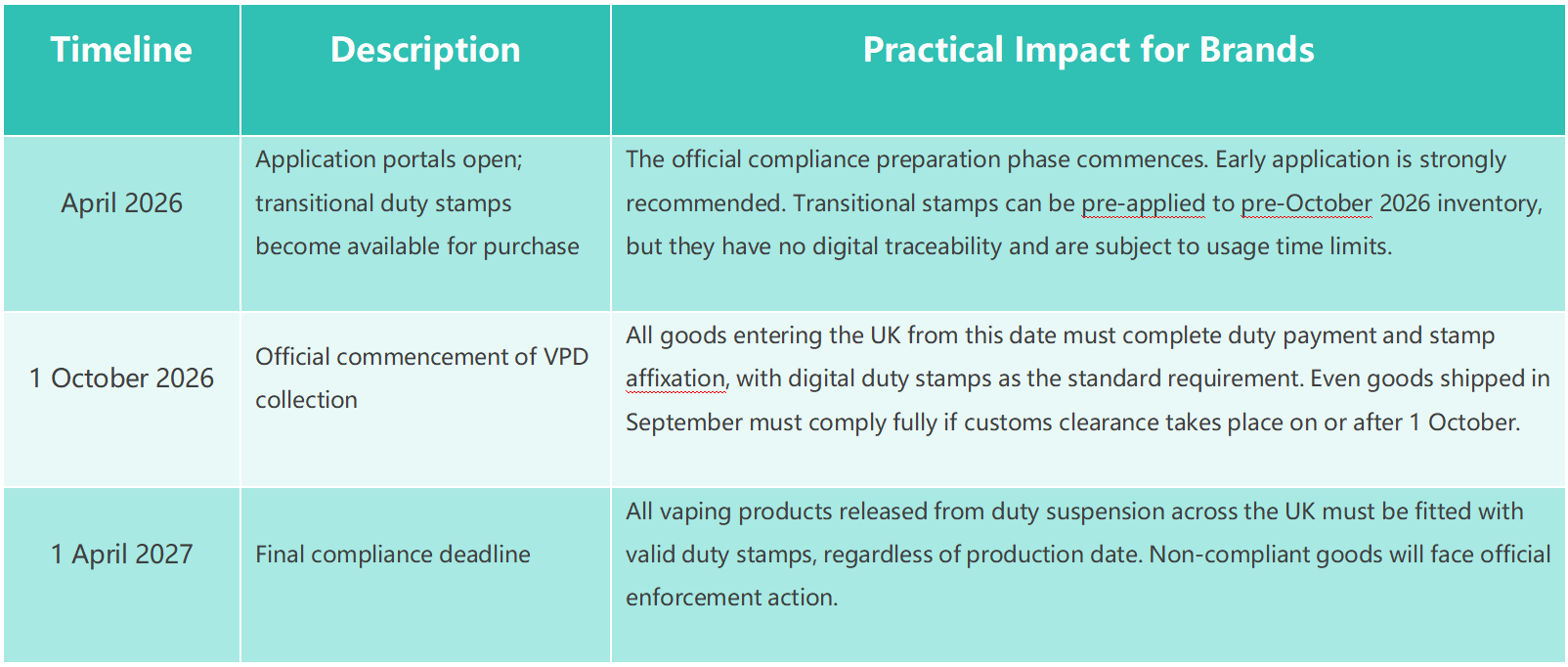
Duty and Tax Calculation
Excise Duty
A unified duty rate of £0.22 per millilitre applies to all vaping products, including:
disposable vapes;
pod systems;
replacement pods;
bottled e-liquids.
The duty applies regardless of nicotine content. This means zero-nicotine products are also subject to VPD.
VAT
The standard UK VAT rate is 20%.
VAT is calculated on the total taxable amount, which may include:
the value of the goods;
import-related costs;
customs duty;
excise duty;
other applicable charges.
As a result, Vaping Products Duty forms part of the amount on which VAT is calculated.
Duty Stamp Production Cost
When ordering duty stamps, brands or authorised parties must pay the stamp production cost to Cartor Security Printers Limited, HMRC’s appointed duty stamp supplier.
⚠️The stamp fee covers only the production cost of the stamps themselves. It does not include excise duty. The relevant excise duty may be paid when the goods are released from a bonded warehouse.
Dual Compliance Is Required
Vaping products will be subject to parallel oversight by MHRA and HMRC. Compliance with both frameworks is essential.
The division of responsibilities is as follows:
MHRA — Medicines and Healthcare products Regulatory Agency
Oversees product safety, capacity limits, nicotine concentration and other product-related regulatory requirements.
HMRC — His Majesty’s Revenue and Customs
Administers VPD, including account approval, duty stamp sales, duty collection and back-end data monitoring.
UK Border Force
Conducts border checks to verify whether imported goods carry valid duty stamps.
Trading Standards
Carries out inspections at physical retail outlets to check the authenticity of duty stamps.
UK Representative and Duty Stamp Application
Under the relevant rules, overseas manufacturers are required to appoint a UK representative to apply under the VDS.
If no UK representative is appointed, the importer must ensure that duty stamps are affixed before the goods leave customs control or a duty-suspension arrangement.
A UK representative must have a fixed place of business in the UK. Under the VDS regime, the UK representative acts as the responsible party for the overseas manufacturer and assumes the relevant legal and financial obligations.
These responsibilities include:
applying for VDS registration;
purchasing duty stamps;
managing duty stamp compliance;
storing and transferring stamps securely;
maintaining complete records;
handling lost stamps and other reportable incidents.
Any breach of duty stamp requirements may result in penalties for the UK representative.
Brands should also be aware that an unprofessional or irresponsible UK representative may put their VPD account at risk, potentially leading to suspension or revocation. In addition, if other brands represented by the same party encounter compliance issues, your brand may also be subject to related inspections or official enquiries.
⚠️ For this reason, brands should conduct proper due diligence when appointing a UK representative. Contractual provisions should also be used to manage risks relating to stamp use, data ownership, termination arrangements and compliance responsibilities.
This helps ensure that the brand retains long-term control over its UK tax data, supply chain records and compliance strategy.
Duty Stamp Placement
Duty stamps measure approximately 18 mm × 42 mm and are available in both self-adhesive and non-adhesive formats.
HMRC requires the stamp to be affixed in a prominent position on the smallest retail packaging unit and applied in a tamper-evident way.
It is recommended that the stamp be placed across the pack seal, so that it is damaged when the pack is opened.
The stamp must not cover any TPD health warnings.

Making Strategic Use of Bonded Warehouses
Under the tax rules, excise duty becomes payable when goods enter market circulation.
Brands may therefore store products in an HMRC-supervised bonded warehouse and release goods as needed. Duty and related charges can then be paid based on the actual quantity released from the warehouse.
This approach can help reduce pressure on working capital and provide greater flexibility in inventory management.
Applying Duty Stamps at Overseas Production Sites
Under the regulatory framework, a UK representative may send duty stamps to overseas manufacturers by post or through secure logistics arrangements, allowing stamp application to be completed at the production site.
The UK representative must establish appropriate controls, including:
secure logistics procedures for stamp delivery;
complete receipt and dispatch records;
dedicated URN ledgers;
incident reporting procedures.
If duty stamps are lost in transit, the stamp supplier must be notified by the end of the next working day after the loss is discovered. Relevant details, including the URN, must be provided.
Failure to report incidents, incomplete records or the diversion of duty stamps into illegal channels may result in regulatory sanctions.
Any wastage occurring during stamp application must also be fully documented. Records should include:
quantity;
URN codes;
time of occurrence;
reason;
supporting evidence of handling or disposal.
The overall wastage rate must be monitored throughout the process and kept within a reasonable range recognised by industry practice and regulatory expectations.
If the wastage rate exceeds the reasonable threshold, a specific explanation may need to be submitted to the regulator. Failure to do so may lead to penalties.
Zinwi Bio operates intelligent, highly automated integrated production lines. Drawing on years of international export experience, Zinwi Bio has developed extensive hands-on expertise in duty stamp compliance across global markets.
With in-depth knowledge of regional duty stamp requirements, Zinwi Bio can support brand partners in implementing end-to-end duty stamp application compliance for the UK market efficiently and reliably.

Three Immediate Priorities for Brands
1. Review Your Product Portfolio
Assess the profitability of each SKU under the new duty rate.
Brands should consider whether product adjustments are required and plan pricing across different price bands in advance.
2. Build a Clear Implementation Timeline
Use 1 October 2026 as the key milestone and work backwards to schedule:
VDS-related applications;
duty stamp procurement;
production planning;
inventory clearance;
export arrangements.
3. Assess In-Transit and Inventory Risks
Identify which shipments and stock may be affected before and after the effective date.
Brands should prepare mitigation plans as early as possible to reduce the risk of customs delays, duty exposure or disruption to UK market supply.

With less than four months remaining until 1 October 2026, early preparation will be critical.
Brands that act now will be better positioned to control compliance costs, maintain supply continuity and protect their momentum in the UK market.
In Part 2, we will cover practical matters such as VDS application procedures, duty stamp purchasing and operational implementation. Stay tuned.


Latest Release
Related Reading
Zinwi Biotech obtains CMMM® Level 2 certification for intelligent manufacturing capability, competing in the new field of intelligent manufacturing
GTNF 2024 is just around the corner and sponsor Zinwi invites you to visit!
Zinwi Christmas E-liquid Flavor Recommendations
Zinwi was awarded the certification of Shenzhen Specialized and New SMEs | Started a new journey of atomization
Meet us at the Dubai : Zinwi Biotech invites you to visit Booth 2014
Business Consulting
E-Liquid ODM/OEM Customization Requirements
Submitted successfully
We will contact you as soon as possible
We will contact you as soon as possible
